Common Granny Square Mistakes and How to Fix Them
Twisting, ruffling, cupping, uneven sides and gappy joins all have simple causes. Find the mistake that matches your square and the fix for it.
Almost every granny square problem traces back to one of three things: too many stitches or chains, too few of them, or tension that changes partway through. Once you can tell which of the three you are looking at, the fix is usually a small one. The table gives the quick diagnosis; the sections below explain each mistake and how to correct it.
| What You See | Most Likely Cause | Quick Fix |
|---|---|---|
| Rounds lean or spiral | Every round worked in the same direction | Turn the square after each round |
| Edges ruffle or wave | Too many stitches or chains | Recount; use fewer chains between clusters |
| Square cups like a bowl | Too few stitches or tight tension | Check corners; loosen up or go up a hook size |
| Sides are different lengths | A cluster added or skipped | Count each side before joining |
| Corners round off | Missing corner chains or cluster | Two clusters and a chain 2 in every corner |
| Center will not take the stitches | Starting ring too small | Chain one or two more, or use a magic ring |
| Gap where rounds join | Thin starting chain, low join | Join into the top chain; move the join |
The stitch names here are US terms: dc means double crochet (the UK treble), ch means chain and sl st means slip stitch. A cluster is a group of 3 dc worked into one space.
The Square Twists or Leans
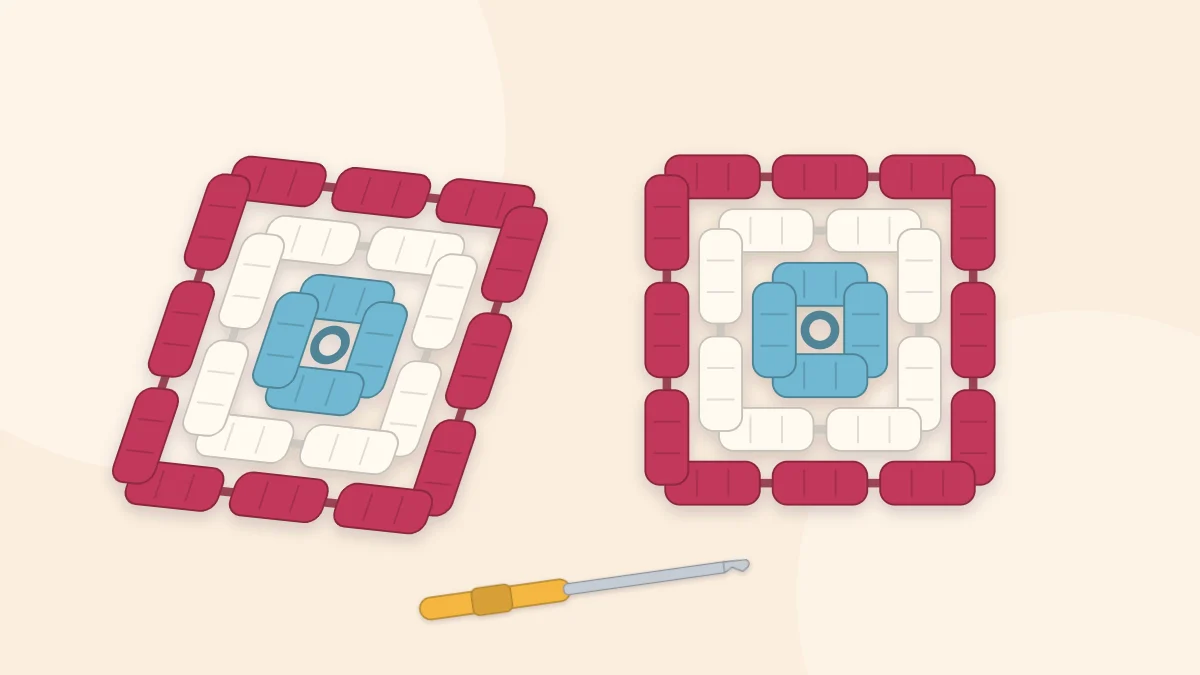
A leaning square looks as if someone has turned the middle a few degrees: the corners of each round sit a little to one side of the corners below. It happens because a crochet stitch does not stand exactly on top of the stitch or space it is worked into, and when every round travels in the same direction, the small offsets add up.
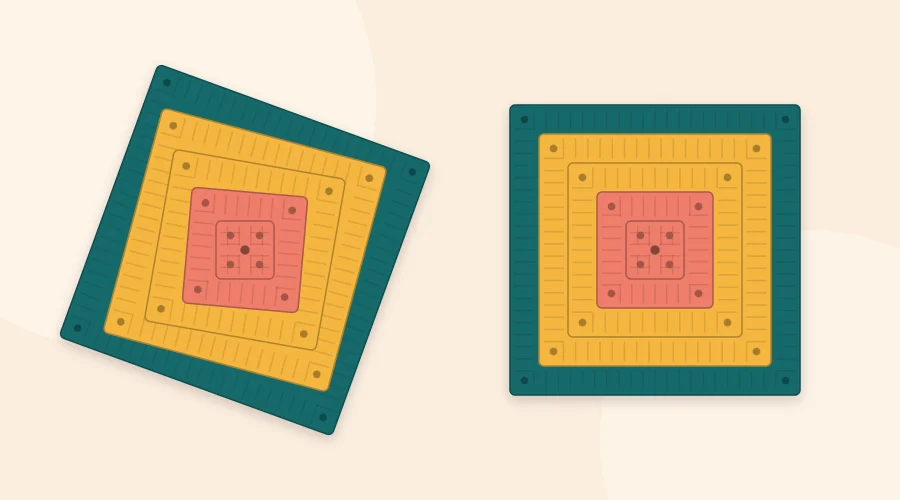
Fix: turn the work over after joining each round, so that alternate rounds run in opposite directions. The lean of one round is cancelled by the next. This matters most on a solid granny square and on large many-round squares, where the drift is easiest to see. A mild lean in a small square can also be pinned straight when blocking.
The Edges Ruffle
Ruffling means the outer round is longer than the square has room for, so the edge waves instead of lying flat. Look for these causes:
- An extra cluster on a side, often two clusters worked into one ch-1 space.
- Ch 2 or ch 3 between side clusters where the pattern says ch 1.
- Corners with more than two clusters, or a corner chain longer than the pattern calls for.
- A hook that is too large for the yarn, which makes every chain long and loose.
Fix: pull back to the last round that lay flat and count. If the count is right and the square still waves, reduce the chains: some crocheters work no chain at all between side clusters, or ch 1 at the corners, because their chains run loose. Either change is fine as long as every square in the project uses it.
The Square Cups
Cupping is the opposite problem. The outer round is too short, so the edges pull up toward you and the square forms a shallow bowl.
- A skipped ch-1 space, leaving one side a cluster short.
- Forgotten corner chains, so the corner cannot open out.
- Tension that tightened as the square grew, which is common when concentrating on a new pattern.
- Chains worked much tighter than the dc stitches.
Fix: count first. If nothing is missing, the cause is tension: loosen your grip, pull each chain up to the full width of the hook shaft, or move up one hook size.
Tip
Lay the square on a table after every round. It is far easier to redo one round than to discover a bowl shape after five.
The Sides Are Uneven
If one side is visibly longer or the square looks like a kite, a cluster has been added or dropped. In a classic square, each side of a round holds the same number of clusters as the round number, counting the corner cluster at each end. Round 3 has 3 per side; round 5 has 5. In a solid square, every side must have the same number of dc, and the stitch most often missed is the first dc after a corner, which hides against the corner stitches.
Fix: count all four sides before making the joining sl st. If you need a refresher on the counts, the classic granny square tutorial lists them round by round.
The Corners Disappear
A square that is turning into a circle has lost its corners. Each corner needs two clusters with a ch 2 between them, all in the same space. One cluster in a corner, or two clusters with no chain, will not turn the edge sharply enough.
Fix: hold the square by its starting corner and check that the four corner spaces line up on the diagonals. If you tend to lose track, slip a stitch marker or a scrap of contrasting yarn into each ch-2 corner space as you make it.
The Starting Ring Is Too Tight
Fitting 12 dc into a ch-4 ring can be a squeeze, particularly with thick yarn or tight chains. Stitches overlap, the center bulges and the first round is hard to count.
Fix: begin with ch 5 or ch 6 for a roomier ring, or use a magic ring, an adjustable loop you crochet into and then pull closed with the tail. If the opposite happens and the center hole looks too big, use the starting tail to tighten it: thread it on a yarn needle, run it around the base of round 1 and draw it in gently before weaving it away.
There Is a Gap at the Join
A beginning ch 3 is thinner than a real dc, so the place where each round starts can show as a narrow gap or a visible line running out from the center.
- Join into the top chain of the ch 3, not into its side.
- Try ch 2 instead of ch 3 if your chains are tall and loose, keeping the stitch count the same.
- When you change color, start each round in a different corner so the joins do not stack.
Watch out
Blocking evens out a slight lean, a gentle ripple or small size differences, but it cannot add a missing cluster or remove an extra one. Fix counting errors with the hook, not with pins.
When the stitch count is right and the square is only a little off, blocking the square usually finishes the job. And if finished squares are flat but do not match each other, the granny square size guide covers how to bring them to the same measurement.
Frequently asked questions
Why is my granny square curling up at the edges?
Curling or cupping means the outer round is too short for the square, usually because a cluster or corner chain was skipped or the tension tightened. Count each side, then try looser chains or a hook one size larger.
Why does my granny square look twisted?
Crochet stitches sit slightly to one side of the stitch below, and working every round in the same direction lets that offset build up. Turning the square over after each round cancels it out.
Can blocking fix a wonky granny square?
Blocking can straighten a mild lean, flatten a gentle ripple and even out small size differences. It cannot correct a wrong stitch count, so missing or extra clusters need to be reworked.
Do I need to start over if I find a mistake?
Usually not. Pull back only to the round where the count went wrong and rework from there; the earlier rounds are unaffected.