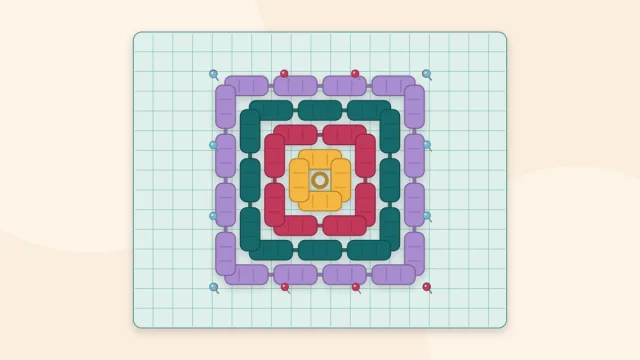
Granny Square Size Guide: How to Measure and Match Your Squares
How to measure a granny square, what makes it bigger or smaller, and how to get a whole stack of squares to come out the same size.
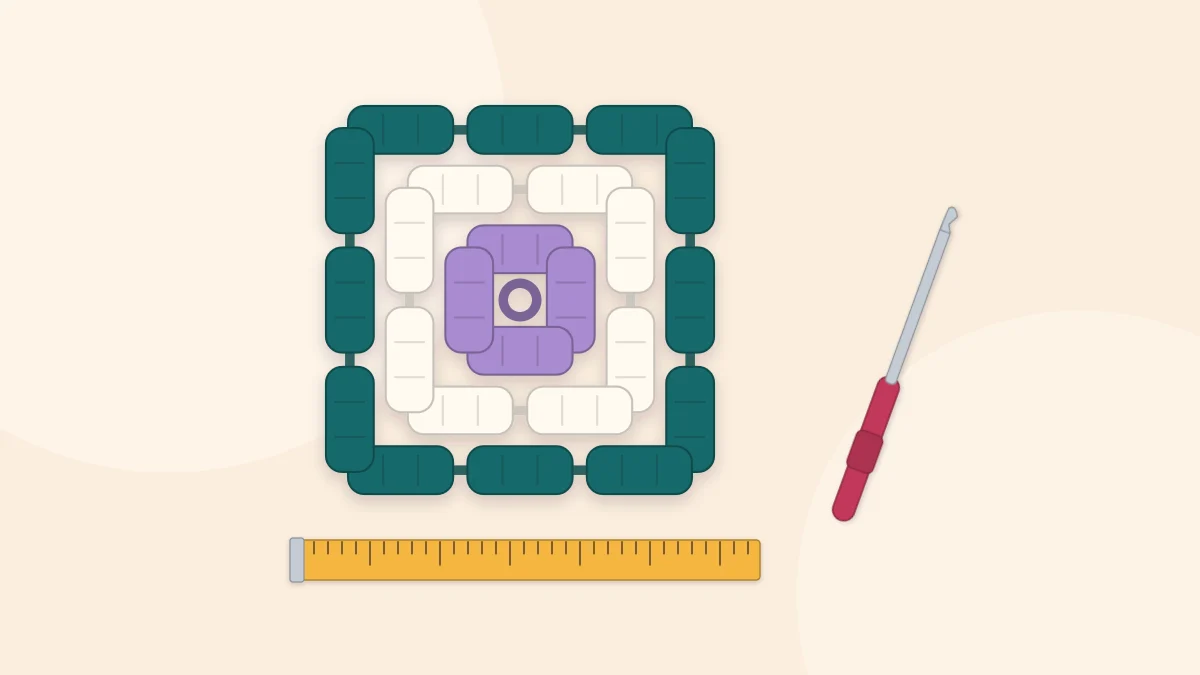
The size of a granny square is the distance across its middle, from one flat side to the opposite side, with the square lying relaxed on a table. Three choices set that number: how many rounds you work, how thick the yarn is, and how large the hook is. Your own tension then nudges it up or down, which is why two people following the same pattern rarely end up with identical squares.
That matters most when squares have to fit together: squares that differ by even a quarter inch will pucker at the seams.
How To Measure A Granny Square
- Lay the square on a hard, flat surface. Do not stretch it and do not smooth it out more than a light pat.
- Place a ruler or a stiff tape across the center, parallel to one side, and read the distance from the outer edge of one side to the outer edge of the opposite side.
- Turn the square a quarter turn and measure again. The two numbers should match. If they do not, the square is being pulled out of shape or a round is missing stitches on one side.
- Write the measurement down together with the yarn, hook size and number of rounds.
Never measure corner to corner. The diagonal is always longer than the side (roughly 1.4 times as long), and corners stretch easily, so the number tells you nothing useful about how the square will fit next to its neighbors.
Tip
Measure a square before and after blocking and note both numbers. Squares usually relax and grow slightly once they have been wetted or steamed and pinned, and the blocked number is the one that counts for planning.
What Changes The Size
Number Of Rounds
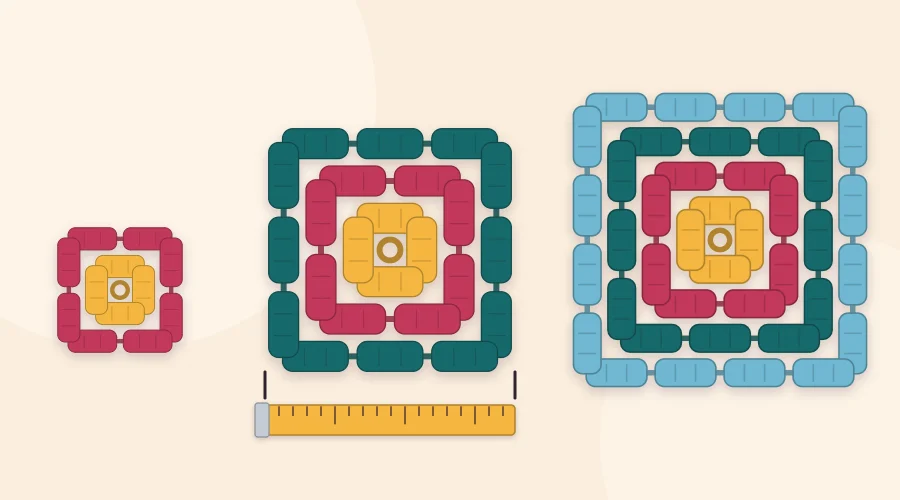
Every round adds a row of stitches to all four sides, so the square grows by two stitch heights each time. In a classic cluster square made of double crochet (dc in US terms; the same stitch is called treble in UK terms), each added round often means a little over 1 in (about 3 cm) of extra width in worsted weight yarn. The table below gives ballpark figures. They are estimates for planning, not measurements you can rely on, because tension differs from one crocheter to the next.
| Rounds | 3-dc clusters in the last round | Approximate size, worsted weight (4), US H-8 (5 mm) hook |
|---|---|---|
| 3 | 12 | About 4 in (10 cm) |
| 4 | 16 | About 5 to 5.5 in (13 to 14 cm) |
| 5 | 20 | About 6.5 in (16.5 cm) |
| 6 | 24 | About 7.5 to 8 in (19 to 20 cm) |
| 7 | 28 | About 9 in (23 cm) |
The cluster column is exact and worth using as a check: a classic granny square has four clusters in round 1 and gains four in every round after that, one extra on each side.
Yarn Weight
Thicker yarn makes taller, wider stitches, so the same pattern comes out larger. A four-round classic square that lands near 5 in (13 cm) in worsted weight (4) may come out around 4 in (10 cm) in DK weight (3) and 6.5 in (16.5 cm) or more in bulky weight (5), each worked with a hook suited to that yarn. Fiber plays a part too: cotton has little stretch and tends to hold its size, while wool and acrylic have more give. The guide to the best yarn for granny squares goes through those differences by project.
Hook Size
With the same yarn, a larger hook makes looser, bigger stitches and a smaller hook makes tighter, smaller ones. Moving up or down one hook size usually changes a small square by a fraction of an inch, which is exactly the kind of adjustment you need when a square is nearly right. See the notes on crochet hook size for granny squares for the usual pairings of hook and yarn.
Tension And Stitch Pattern
Tension is how tightly you hold the yarn, and it can shift from one sitting to the next. Stitch pattern matters as well. A solid square, an open cluster square and a textured square with the same number of rounds will not measure the same, because chains, clusters and raised stitches all take up different amounts of room.
How To Make All Your Squares Match
Start With A Gauge Square
Before starting a project, make one complete square with the yarn and hook you plan to use. Block it the way you will block the finished piece, let it dry, then measure it. This is your gauge square. Keep it beside you and lay each new square on top of it as you go.
Count Before You Adjust
If a square is clearly smaller or larger than the rest, count its rounds and then count the clusters or stitches on each side. A missing round or a skipped cluster is a more common cause than tension, and no amount of stretching will fix it.
Fix Small Differences
- Change the hook. If your squares are getting tighter as the project goes on, move up one hook size. If they are getting looser, move down one.
- Add a round. A final round of single crochet (sc) around a square that runs small typically adds about half an inch (1 to 1.5 cm) to the width. Add it to every square or to none if the color of the last round is part of the design.
- Block to size. Pinning each square to the same outline evens out differences of up to roughly a quarter inch (0.5 cm). The method is covered in how to block granny squares.
- Remake it. A square that is half an inch (1.3 cm) or more out is usually quicker to redo than to force.
Watch out
Blocking cannot rescue a square that is a full round short, and stretching a small square hard to make it fit leaves it thin and distorted. Acrylic also responds less to wet blocking than wool or cotton, so do not count on blocking to fix large differences in acrylic squares.
What Size Should A Granny Square Be?
There is no standard size. Pick the size that suits the project, then choose rounds, yarn and hook to reach it.
- Coasters and garlands: about 4 in (10 cm).
- Bags, scarves and pillow covers: about 4 to 6 in (10 to 15 cm).
- Blankets: about 5 to 8 in (13 to 20 cm). Smaller squares give more color changes and more seams; larger squares work up faster.
- Garments: whatever divides evenly into the chest and length measurements you need, often 4 to 6 in (10 to 15 cm).
Once the size is fixed, the number of squares follows from simple division. The tables in granny square blanket sizes do that arithmetic for common blanket dimensions. Whatever the project, make and measure one finished, blocked square first, and base every other number on it.
Frequently asked questions
What is the standard size of a granny square?
There is no standard size. Many projects use squares between about 4 and 8 inches (10 to 20 cm), and the right size is whatever suits the project and divides evenly into its finished measurements.
How do you measure a granny square correctly?
Lay it flat without stretching and measure straight across the middle from one side to the opposite side, then turn it a quarter turn and measure again. Do not measure corner to corner, because the diagonal is always longer than the side.
Why are my granny squares different sizes?
The usual causes are a change in tension, a different hook or yarn, or a missing round or cluster. Count the rounds and the clusters on each side first, then adjust hook size or block the squares to the same outline.
Can blocking make a granny square bigger?
Blocking can even out small differences, roughly a quarter inch, but it cannot replace a missing round. A square that is much too small is better remade or given an extra round.