Giant Granny Square Blanket: One Square That Keeps Growing
A giant granny square blanket is one classic square worked round after round until it is blanket size. Here is the repeating round, plus how to plan stripes, keep it square and decide when to stop.
Tutorial at a glance
Materials
- Yarn needle
- Scissors
- Locking stitch marker
- Kitchen scale for estimating yarn (optional)
A giant granny square blanket is a single classic granny square that never stops. The same cluster round is repeated, one cluster longer per side each time, until the square is as wide as the blanket needs to be. There are no squares to join and only one round to remember. The planning questions are different from a joined blanket, though: whether to turn the work, how to plan stripes when every round uses more yarn than the last, how to keep a very large square flat, and when to stop.
What You Need
- Worsted weight (4) yarn in one or more colors. The guide to choosing yarn for granny squares covers the fiber trade-offs.
- A US H-8 (5 mm) hook, or a US I-9 (5.5 mm) hook for a softer, looser fabric.
- A yarn needle, scissors and a locking stitch marker.
The pattern is written in standard US crochet terms. A US double crochet is the stitch that UK patterns call a treble.
Abbreviations
- ch = chain
- sl st = slip stitch
- dc = double crochet
- sp = space, ch-sp = chain space
- rnd = round
- rep = repeat
- cluster = 3 dc worked into the same space
The Pattern: One Round, Repeated
This version is turned after every round, so each round begins and ends in the same corner. The starting chain 3 counts as the first dc in every round.
- Start: Ch 4 and sl st into the first ch to form a ring.
- Rnd 1: Ch 3, 2 dc into the ring, ch 2, [3 dc into the ring, ch 2] 3 times, sl st to the top of the ch-3. Turn. Count: 4 clusters (12 dc) and 4 ch-2 corner sps.
- Rnd 2: Sl st into the ch-2 corner sp just made. Ch 3, 2 dc in the same sp, ch 1. [(3 dc, ch 2, 3 dc) in the next corner sp, ch 1] 3 times. 3 dc in the first corner sp, ch 2, sl st to the top of the ch-3. Turn. Count: 8 clusters (24 dc), 4 corner sps and 4 ch-1 sps.
- Rnd 3 and every later rnd: Sl st into the corner sp just made. Ch 3, 2 dc in the same sp, ch 1. *[3 dc in the next ch-1 sp, ch 1] along the side to the next corner, (3 dc, ch 2, 3 dc) in the corner sp, ch 1; rep from * 2 more times. [3 dc in the next ch-1 sp, ch 1] along the last side, 3 dc in the first corner sp, ch 2, sl st to the top of the ch-3. Turn.
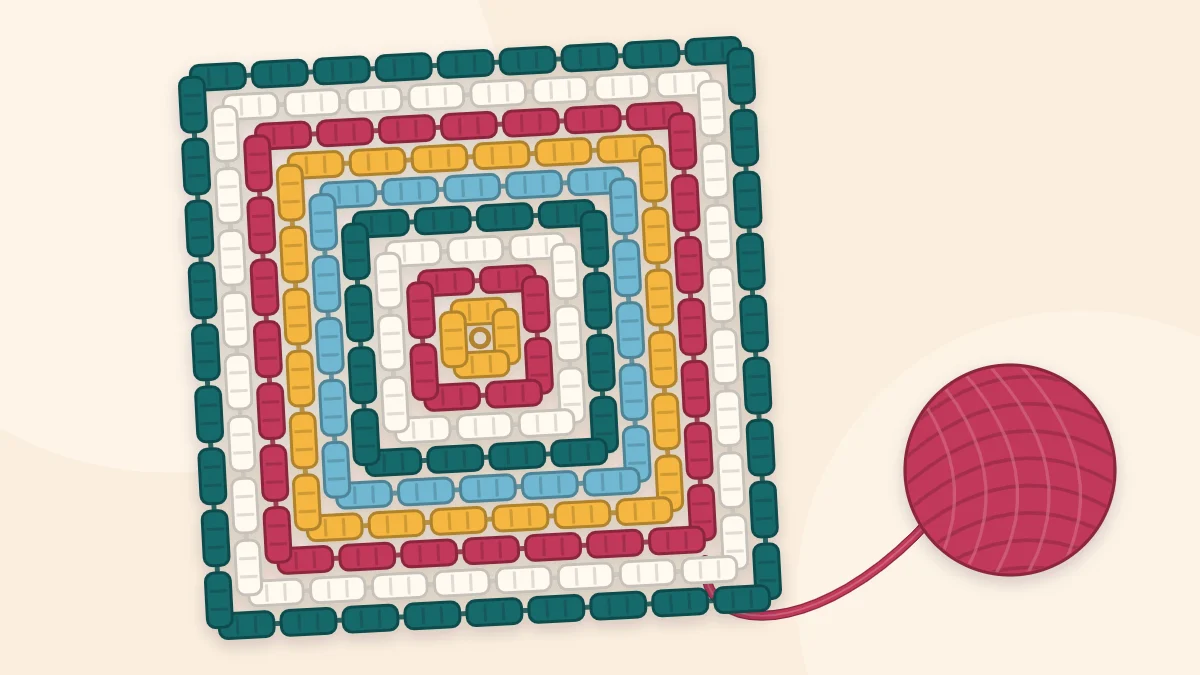
Every round adds one cluster to each side. The classic granny square tutorial walks through the first three rounds slowly.
| Round | Clusters Per Side | Clusters in the Round | Dc in the Round | Clusters So Far |
|---|---|---|---|---|
| 1 | 1 | 4 | 12 | 4 |
| 10 | 10 | 40 | 120 | 220 |
| 20 | 20 | 80 | 240 | 840 |
| 30 | 30 | 120 | 360 | 1,860 |
“Clusters per side” counts the half of a corner group at each end of the side. To check a round, count one side: it should hold as many clusters as the round number.
Turn the Work or Keep Going the Same Way?
A small granny square can be worked with the right side always facing. Over dozens of rounds, though, the slight slant of each double crochet can add up, and the whole square may start to spiral. Turning after every round sends the slant one way and then the other, which is why turning is the usual advice for a giant square. It also puts the hook right beside the corner space where the next round begins.
The price is that the fabric has no distinct right side; both faces show a mix of stitch fronts and backs. To work without turning instead, begin each round with a full corner, (ch 3, 2 dc, ch 2, 3 dc) in the corner sp, finish the last side with ch 1 and a sl st to the top of the ch-3, then sl st in the next 2 dc and into the corner sp to reach the start of the next round. The cluster counts are the same either way.
Planning Stripes When Every Round Is Bigger
Yarn use follows the cluster count, and the cluster count climbs fast. Round 30 on its own (120 clusters) takes more yarn than rounds 1 to 7 together (112 clusters). In a 30-round blanket, the last ten rounds hold 1,020 of the 1,860 clusters, which is more than half of all the yarn.
- Equal-width stripes: the outer stripes need far more yarn than the inner ones, so save the colors with the most yardage for the outside.
- Equal-yarn stripes: if each color comes in the same size ball, the stripes get narrower as the blanket grows. Rounds 1 to 13 (364 clusters) use about as much as rounds 28 to 30 (348 clusters).
To put numbers on it, weigh the ball on a kitchen scale before and after one full round and divide the grams used by the clusters in that round. Multiply that figure by the clusters still to come. Change color at the end of a round so the join sits in a corner; clean joins are covered in the guide to changing colors in a granny square.
Tip
Clip a locking stitch marker into the corner space where each round starts. On a large square the four corners look identical.
Keeping a Big Square Flat and Square
- Wavy, ruffled edges mean there is too much fabric in each round. Leave out the ch 1 between side clusters, keeping the ch 2 at the corners, or go down one hook size.
- A cupped, bowl-shaped square means the rounds are too tight. Go up a hook size, loosen the chains, or work ch 3 at the corners.
- One side longer than the others is nearly always a skipped ch-1 space or an extra cluster. Count each side every few rounds.
Lay the blanket flat every ten rounds or so, because problems are easier to see at full size. More causes and fixes are listed under common granny square mistakes.
When to Stop
Stop at the end of a complete round, when the square measures the width wanted. Growth per round depends on yarn, hook and tension, so measure rather than trust a number: after ten rounds, lay the square flat, measure it side to side and divide by ten. Divide the target width by that figure to estimate the total rounds. As a rough guide only, worsted weight yarn on a US H-8 (5 mm) hook often adds somewhere around 1 to 1.5 in (2.5 to 4 cm) of width per round, which would put a 36 in (91 cm) baby blanket at roughly 24 to 36 rounds.
Finish by weaving in the ends and working a simple edging to firm up the last round.
Frequently asked questions
How many rounds does a giant granny square blanket need?
It depends on yarn, hook and tension. Work ten rounds, measure the square side to side, divide by ten to get the growth per round, then divide the width wanted by that figure.
Should a giant granny square be turned after every round?
Turning is the usual advice for a very large square because it helps stop the rounds from slanting in one direction and twisting the square. The trade-off is a reversible fabric with no single right side.
Why is the edge of the blanket getting wavy?
Ruffling means each round has too much fabric. Leave out the chain 1 between side clusters, keeping the chain 2 at the corners, or switch to a hook one size smaller.
How much yarn do the outer rounds use?
Much more than the inner ones, because each round has four more clusters than the one before. In a 30-round blanket the last ten rounds contain 1,020 of the 1,860 clusters, more than half of the total.