Solid Granny Square: An Easy No-Gap Double Crochet Pattern
A solid granny square fills in the gaps of the classic version with rows of double crochet. Here is a four-round pattern with counts, plus ways to stop it leaning.
Tutorial at a glance
Materials
- Yarn needle
- Scissors
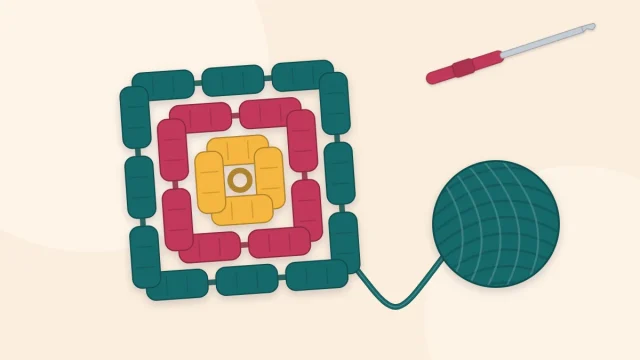
A solid granny square replaces the airy clusters and chain gaps of the classic square with an unbroken fabric of double crochet. It still grows outward from a center ring, one round at a time, but the only openings are the four chain-2 corners. The result is denser, warmer and less see-through, which makes it a good choice for blankets, pillow fronts, bags and anything that should not let fingers or light poke through.
How It Differs From the Classic Square
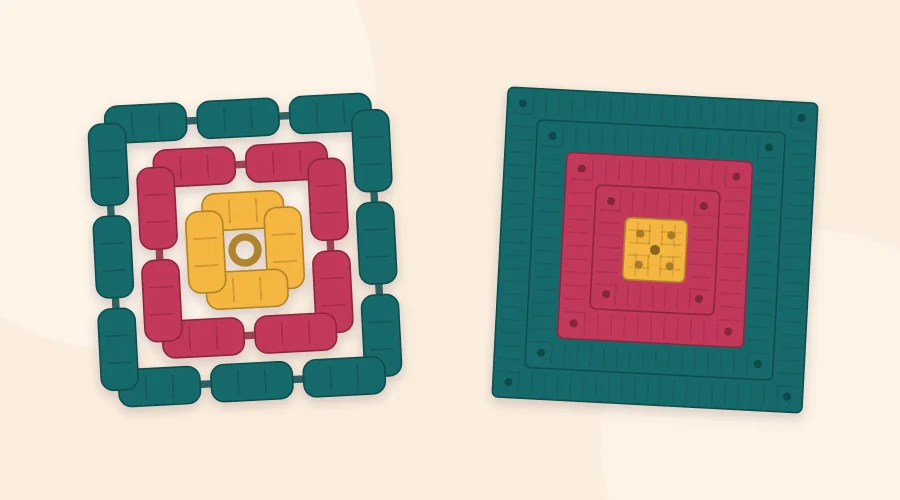
If you already know how to crochet a classic granny square, the main change is where the hook goes. A classic square is worked into spaces. A solid square is worked into the top of every stitch, with only the corners worked into a space.
| Feature | Classic Granny Square | Solid Granny Square |
|---|---|---|
| Where stitches go | Into chain spaces | Into stitch tops, plus corner spaces |
| Gaps | Between every cluster | At the four corners only |
| Growth per round | 1 cluster per side | 4 dc per side |
| Fabric | Open and drapey | Dense and sturdy |
| Yarn used | Less for the same size | More for the same size |
Materials
- Worsted weight (4) yarn in one color. Smooth yarn shows the neat rows of stitches best.
- US H-8 (5 mm) hook. Drop to a US G-6 (4 mm) hook for a firmer fabric such as a coaster or bag panel.
- Yarn needle and scissors.
Four rounds in this yarn and hook come out at roughly 5 in (13 cm) across. That figure is an estimate and shifts with yarn and tension, so measure your own first square.
Abbreviations
The pattern uses US terms; the US double crochet is the UK treble.
- ch = chain
- sl st = slip stitch
- dc = double crochet
- st(s) = stitch(es)
- sp = space
- rnd = round
- corner = (2 dc, ch 2, 2 dc) all worked into one ch-2 corner space
Stitches inside parentheses go into one space. A sequence inside square brackets is repeated the number of times stated after it.
Solid Granny Square Pattern
Do not turn the work; the right side faces you throughout. The beginning ch 3 counts as a dc in every round.
Round 1
- Ch 4 and sl st into the first chain to form a ring (or start with a magic ring).
- Ch 3, work 2 dc into the ring, ch 2.
- [3 dc into the ring, ch 2] 3 times.
- Join with a sl st to the top of the beginning ch 3.
Count: 12 dc and 4 ch-2 corner spaces, 3 dc on each side.
Round 2
- Ch 3, dc in each of the next 2 dc.
- [Corner in the next ch-2 sp, dc in each of the next 3 dc] 3 times.
- Corner in the last ch-2 sp.
- Join with a sl st to the top of the beginning ch 3.
Count: 28 dc and 4 ch-2 corner spaces, 7 dc on each side.
Round 3
- Ch 3, dc in each of the next 4 dc.
- [Corner in the next ch-2 sp, dc in each of the next 7 dc] 3 times.
- Corner in the last ch-2 sp, dc in each of the last 2 dc.
- Join with a sl st to the top of the beginning ch 3.
Count: 44 dc and 4 ch-2 corner spaces, 11 dc on each side.
Round 4
- Ch 3, dc in each of the next 6 dc.
- [Corner in the next ch-2 sp, dc in each of the next 11 dc] 3 times.
- Corner in the last ch-2 sp, dc in each of the last 4 dc.
- Join with a sl st to the top of the beginning ch 3. Fasten off and weave in the ends.
Count: 60 dc and 4 ch-2 corner spaces, 15 dc on each side.
Watch out
The first dc after each corner sits tight against the corner stitches and is easy to skip. If a side comes up one stitch short, that hidden stitch is the first place to look.
Going Bigger
The rule for any later round is simple: one dc in every dc, and a corner in every corner space. Each corner adds 2 dc to the end of one side and 2 dc to the start of the next, so every side grows by 4 dc per round. For round number n, a side has 4n minus 1 stitches and the whole round has 16n minus 4. Round 5 is 19 dc per side and 76 in total; round 6 is 23 per side and 92 in total.
Because the seam where rounds join sits in the middle of a side, the stretch of dc before the first corner gets 2 stitches longer every round, and so does the stretch after the last corner. There is no need to memorize those numbers. Work to the corner space, then count the finished side.
How to Keep It From Twisting
Solid squares have a habit of leaning: the corners drift round like a pinwheel and the square looks slightly rotated. A double crochet does not sit exactly above the stitch it is worked into, and when every round runs in the same direction, those small offsets stack up. Several things reduce it.
- Turn after every round. Join, ch 3, turn the square over and work the next round in the opposite direction. The offsets then cancel out. The stitch count per side stays the same, but the number of dc before the first corner changes, so work “dc in each dc to the corner” rather than following the numbers above.
- Keep the count exact. A skipped or doubled stitch beside a corner pushes that corner out of line, which looks like twisting even when it is not.
- Relax the tension. Very tight stitches lean more. If the fabric feels stiff, try a hook one size larger.
- Block the finished square. Pinning the corners square and letting the fabric dry in shape corrects a mild lean; the method is covered in the guide to blocking granny squares.
Tip
Turned rounds show both the front and the back of the stitches, which gives a slightly more textured surface. Choose turning or not turning before you start and use the same method for every square in a project.
If the square ruffles, cups or loses a corner instead of leaning, the cause is usually a count or chain problem, and the list of common granny square mistakes goes through each one. To see how the solid square compares with sunburst, flower and textured squares, read the overview of the types of granny squares.
Frequently asked questions
Why does my solid granny square twist?
Each double crochet sits slightly to one side of the stitch below it, and when every round is worked in the same direction the offsets add up. Turning the work after each round, keeping the count exact and blocking all reduce the lean.
How many stitches does each round of a solid granny square have?
With chain-2 corners and two double crochets on each side of the corner, round 1 has 12 stitches and every round adds 16. Each side has four times the round number minus one stitches.
Does a solid granny square use more yarn than a classic one?
For the same finished size it generally does, because stitches replace the chain gaps. The exact difference depends on yarn, hook and tension, so work a sample square before buying yarn for a large project.