Types of Granny Squares: 7 Styles and Who Each One Suits
From the classic cluster square to sunbursts, flowers and mitered designs, here are the main granny square families and how to pick between them.
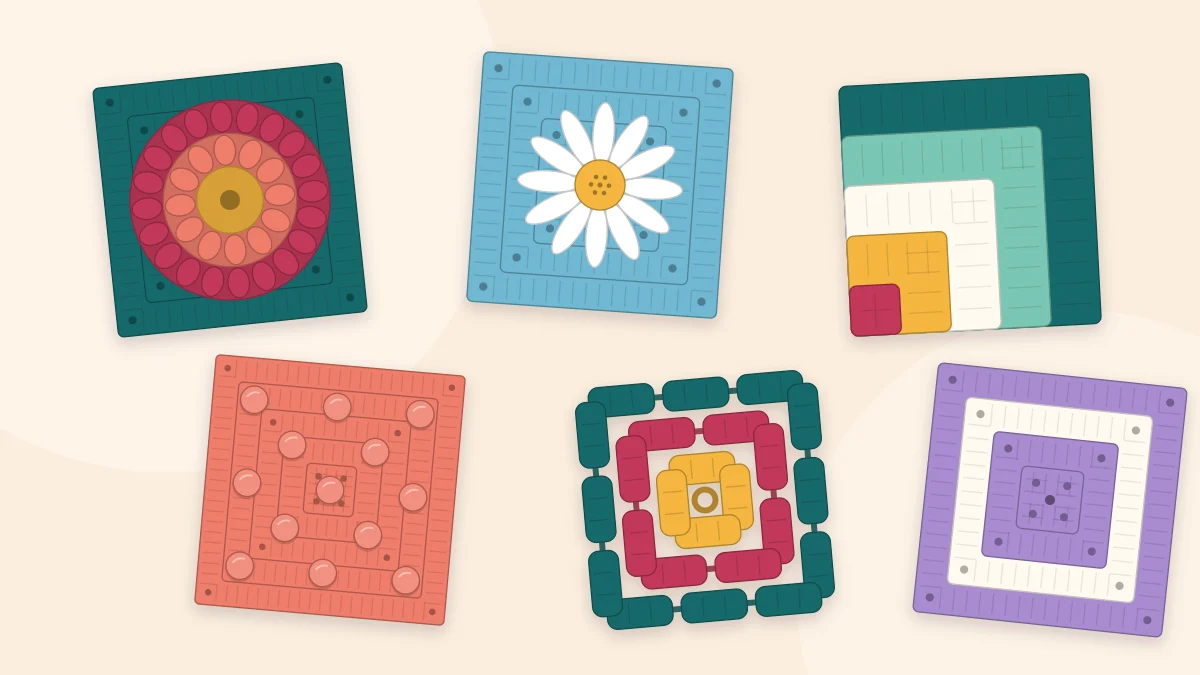
Granny squares fall into seven broad families: classic cluster squares, solid squares, circle-in-a-square designs such as the sunburst, flower squares, textured squares, mitered and other geometric squares, and the giant square that grows into a whole blanket. They share one idea, a small motif with four corners that can be repeated and joined, but they differ in how they are built, how much yarn and patience they ask for, and what they are good at. This overview sets out each family, who it suits and where to start.
Stitch names below are US terms: dc is double crochet (called treble in UK terms), sc is single crochet and tr is treble crochet.
The Seven Families at a Glance
| Type | How It Is Built | Fabric | Level |
|---|---|---|---|
| Classic | Groups of 3 dc worked into spaces, in rounds | Open, drapey | Beginner |
| Solid | A dc in every stitch, chain corners | Dense, warm | Beginner |
| Circle in a square | Round center squared off in the last round | Medium, bold center | Advanced beginner |
| Flower | Petal center with a background squared around it | Raised center, flat frame | Intermediate |
| Textured | Solid base with bobbles, popcorns or puffs | Thick, bumpy | Intermediate |
| Mitered and geometric | L-shaped rows from one corner, or color blocks | Flat, graphic | Advanced beginner |
| Giant | One classic square continued for many rounds | Open, drapey | Beginner |
The levels are a general guide. A patient beginner can make any of these; the higher levels simply involve more stitches to learn or more counting.

Classic Granny Square
This is the square most people picture: clusters of three double crochet separated by small gaps, with a new color on each round. It is worked into spaces, not into individual stitches, which makes it forgiving for anyone still learning to find the top of a stitch. It works up quickly, uses relatively little yarn and is the traditional way to use up leftover colors.
Suits: first-time crocheters, scrap-yarn projects, light blankets, scarves and garments that need drape. Start with the step-by-step guide to crocheting a classic granny square.
Solid Granny Square
A solid square has a double crochet in every stitch, so the only openings are the four corners. The fabric is thicker and warmer than the classic version and shows off a single color or wide stripes cleanly. The trade-offs are that it takes more yarn for the same size, and that counting matters: every side has to end up with the same number of stitches.
Suits: beginners ready for a second pattern, warm blankets, pillow covers, bags and coasters. The solid granny square pattern gives the count for every round.
Circle in a Square and Sunburst
These squares begin as a flat circle, often two or three rounds of puff stitches or clusters in changing colors, and are turned into a square in the final round by working taller stitches at four evenly spaced points. The contrast between a round, colorful center and a plain frame is what gives the style its impact. The sunburst is the best known version.
Suits: crocheters comfortable with the classic square who want to learn puff and cluster stitches, and blankets where each square is a small picture. The sunburst granny square tutorial walks through a four-round version.
Flower Granny Squares
Flower squares put a petaled motif in the center, such as a daisy, a sunflower or a simple five- or eight-petal bloom, and then build a background around it until the outline is square. Some petals lie flat and some are layered so they stand slightly proud of the background. They take longer per square than the plain families because of the color changes and the extra ends to weave in.
Suits: intermediate crocheters, spring and summer projects, baby blankets, bags and cardigans with a feature panel. The basic flower granny square is the place to learn the construction before trying a daisy or sunflower.
Textured Granny Squares
Textured squares usually start from a solid base and add raised stitches to it. The three common ones are the bobble (several partly worked double crochets closed together), the popcorn (a group of complete double crochets gathered at the top) and the puff (loops of yarn drawn up and closed together). All three create bumps on the surface, but they differ in how firm and how prominent the bump is.
Suits: single-color projects where the interest comes from the surface, pillow covers and blanket squares mixed in among plainer ones. Textured squares use noticeably more yarn than a plain square of the same size, so make a sample before buying for a large project.
Mitered and Geometric Squares
A mitered square does not start in the middle. It begins at one corner and grows in L-shaped rows, so stripes run around two sides and meet in a diagonal line. Other geometric looks belong in the same family: half-and-half squares split into two colors, diagonal color blocks and squares made of four smaller triangles. Arranged in different rotations, the same square can produce chevrons, diamonds or pinwheels across a blanket.
Suits: crocheters who like modern, graphic layouts and are happy turning the work at the end of each row.
Giant Granny Square
The giant square is the classic pattern with no stopping point: you keep adding rounds until the square is the size of a lap blanket or a bedspread. There is nothing to join and very few ends if you work wide stripes. The rounds do get long, and a large square can start to lean unless the work is turned every round or two.
Suits: beginners who want a blanket without sewing, and anyone who prefers one continuous, portable-at-first project.
How to Choose
- For a first project: classic, then solid.
- For the warmest fabric: solid or textured.
- For using up scraps: classic or sunburst, where every round can be a different color.
- For the least sewing: giant.
- For a showpiece: flower, sunburst or textured squares, possibly alternated with plain ones.
Tip
Different families can share one blanket as long as the finished squares measure the same. Make one of each, measure them, and add or remove a plain final round until they match.
Whichever type you choose, the size of a square depends on your own yarn, hook and tension, so a single sample square is the most useful thing you can make before committing to a project.
Frequently asked questions
What is the easiest type of granny square?
The classic cluster granny square is usually the easiest, because the stitches are worked into spaces instead of individual stitch tops. The solid square is a good second pattern.
Can I mix different types of granny squares in one blanket?
Yes, provided the finished squares are the same size. Make a sample of each type, measure them, and adjust with an extra plain round or blocking until they match.
What is the difference between a classic and a solid granny square?
A classic square is made of groups of three double crochets with gaps between them. A solid square has a double crochet in every stitch, so it only has openings at the four corners.