Granny Square Coasters: A Quick Cotton Crochet Pattern
Small cotton granny squares make practical coasters. This quick pattern uses three cluster rounds and a single crochet edge, worked at a tight gauge so each coaster lies flat.

Tutorial at a glance
Materials
- Yarn needle
- Scissors
- Pins and a towel or mat for blocking (optional)
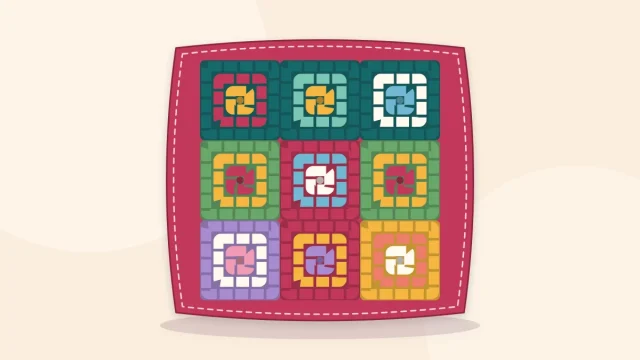
Granny square coasters are small cotton squares, three rounds of classic clusters plus one round of single crochet, worked tightly so they lie flat under a mug. Each one comes out at roughly 4 in (10 cm) across and takes well under an hour, which makes a set of four a realistic one-evening project and a good use for leftover yarn. They are also a low-stakes way to practice the granny square before committing to a blanket.
Why Cotton Is the Right Fiber
A coaster has two jobs: soak up drips and condensation, and sit between a hot or cold cup and the table. Cotton suits both.
- It absorbs. Cotton takes up water readily, so drips stay in the coaster instead of pooling under the glass.
- It tolerates heat. Cotton copes with the warmth of a hot mug. Acrylic is a plastic-based fiber that can soften or be damaged by high heat, and it does not absorb much water.
- It holds a crisp shape. Cotton has little stretch, so a small square stays square.
- It washes easily. Coasters meet coffee and tea every day, and most cotton yarn can go through a regular machine wash. Check the label on the ball.
Plain, unmercerized worsted weight (4) cotton, the matte kind often sold for dishcloths, is the most absorbent choice. Mercerized cotton is smoother and shinier and shows stitches clearly, but it tends to be a little less thirsty.
Materials for a Set of Four
- Worsted weight (4) cotton yarn, roughly 20 to 25 yards (18 to 23 m) per coaster as an estimate, in 1 to 3 colors
- US G-6 (4 mm) hook
- Yarn needle and scissors
Size and Gauge
A standard mug base is around 3 in (7.5 cm) wide, so a coaster of about 4 in (10 cm) leaves a small margin all around. The hook here is deliberately smaller than the size usually paired with worsted weight yarn. A tight gauge closes up the gaps between clusters, makes a denser pad and stops the coaster from being floppy. Size still depends on the yarn and on individual tension, so make one, measure it flat, and change the hook if it is far off: a US 7 (4.5 mm) hook for a larger, softer coaster, or a US F-5 (3.75 mm) hook for a smaller, firmer one.
Abbreviations and Special Terms (US)
Standard US terms are used. US double crochet is UK treble, and US single crochet is UK double crochet.
- ch = chain
- sl st = slip stitch
- sc = single crochet
- dc = double crochet
- st(s) = stitch(es)
- sp = space
- rnd = round
- rep = repeat
- cluster = 3 dc worked into the same space
- magic ring = an adjustable loop of yarn wrapped around the fingers; the first round is worked into the loop, and the tail is then pulled to close the center hole completely
The Coaster Pattern
The ch 3 at the start of Rnds 1 to 3 counts as a dc. The work is not turned.
- Start: Ch 4 and sl st into the first ch to form a ring, or make a magic ring for a closed center.
- Rnd 1: Ch 3, 2 dc into the ring, ch 2, [3 dc into the ring, ch 2] 3 times, sl st to the top of the ch-3. Count: 4 clusters (12 dc), 4 ch-2 corner sps.
- Rnd 2: Sl st in the next 2 dc and into the corner sp. (Ch 3, 2 dc, ch 2, 3 dc) in the same sp, ch 1, [(3 dc, ch 2, 3 dc) in the next corner sp, ch 1] 3 times, sl st to the top of the ch-3. Count: 8 clusters (24 dc), 4 corner sps, 4 ch-1 sps.
- Rnd 3: Sl st in the next 2 dc and into the corner sp. (Ch 3, 2 dc, ch 2, 3 dc) in the same sp, ch 1, 3 dc in the next ch-1 sp, ch 1, [(3 dc, ch 2, 3 dc) in the next corner sp, ch 1, 3 dc in the next ch-1 sp, ch 1] 3 times, sl st to the top of the ch-3. Count: 12 clusters (36 dc), 4 corner sps, 8 ch-1 sps.
- Rnd 4 (edge): Ch 1 (does not count as a st), sc in the same st as the join, sc in the next 2 dc, 3 sc in the corner sp. *Sc in the next 3 dc, [sc in the next ch-1 sp, sc in the next 3 dc] twice, 3 sc in the corner sp; rep from * 2 more times. Sc in the next 3 dc, sc in the next ch-1 sp, sc in the next 3 dc, sc in the last ch-1 sp, sl st to the first sc. Count: 56 sc. Fasten off.
To check Rnd 4, count one side: 9 sc in the dc and 2 sc in the ch-1 sps make 11, and four sides make 44. The four corners add 3 sc each, 12 more, for 56. New to the cluster rounds? The full walk-through is in how to crochet a granny square.
Tip
For a set that clearly belongs together, keep the edge round the same color on all four coasters and change only the inner rounds.
Finishing So They Sit Flat
Weave each tail through the base of the stitches on the back, changing direction at least once, and trim it close. Coasters are washed often, so short or loosely tucked ends tend to work their way out; the method is covered in how to weave in ends on granny squares.
Cotton responds well to wet blocking. Dampen the coasters, pin each one square on a towel or mat to the same measurement, and leave them to dry. The steps are in how to block granny squares.
Watch out
Dark and bright cotton shades can release dye when wet. Rinse a finished coaster in cool water before using it on a pale tablecloth or unsealed wood.
Easy Variations
- No gaps at all: if drips reaching the table are a worry, use the same yarn and hook with a solid granny square, which has no spaces between stitches.
- Thicker pad: make two squares through Rnd 3, hold them with wrong sides together, and work Rnd 4 through both layers at once. The 56 sc join the two into one double-thick coaster.
- Larger mat: add a fourth cluster round before the edge for a mug rug of about 5 in (12.5 cm). That round has 16 clusters (48 dc), and the edge round then has 12 dc and 3 ch-1 sps per side, 15 sc, plus 12 corner sc: 72 sc.
Frequently asked questions
What is the best yarn for crochet coasters?
Worsted weight cotton is the usual choice because it absorbs moisture, tolerates the warmth of a hot mug and washes easily. Acrylic absorbs little water and can be damaged by high heat.
What size should a granny square coaster be?
About 4 in (10 cm) across suits most mugs and glasses, leaving a small margin around the base. Add a round for a larger mug rug of about 5 in (12.5 cm).
How do you keep crochet coasters flat?
Work at a tight gauge with a hook smaller than usual for the yarn, finish with a round of single crochet, and wet block the coasters pinned square until dry.