How to Crochet a Granny Square: A Step-by-Step Beginner Tutorial
Learn the classic three-round cluster granny square, from the starting ring to fastening off, with a stitch count for every round.
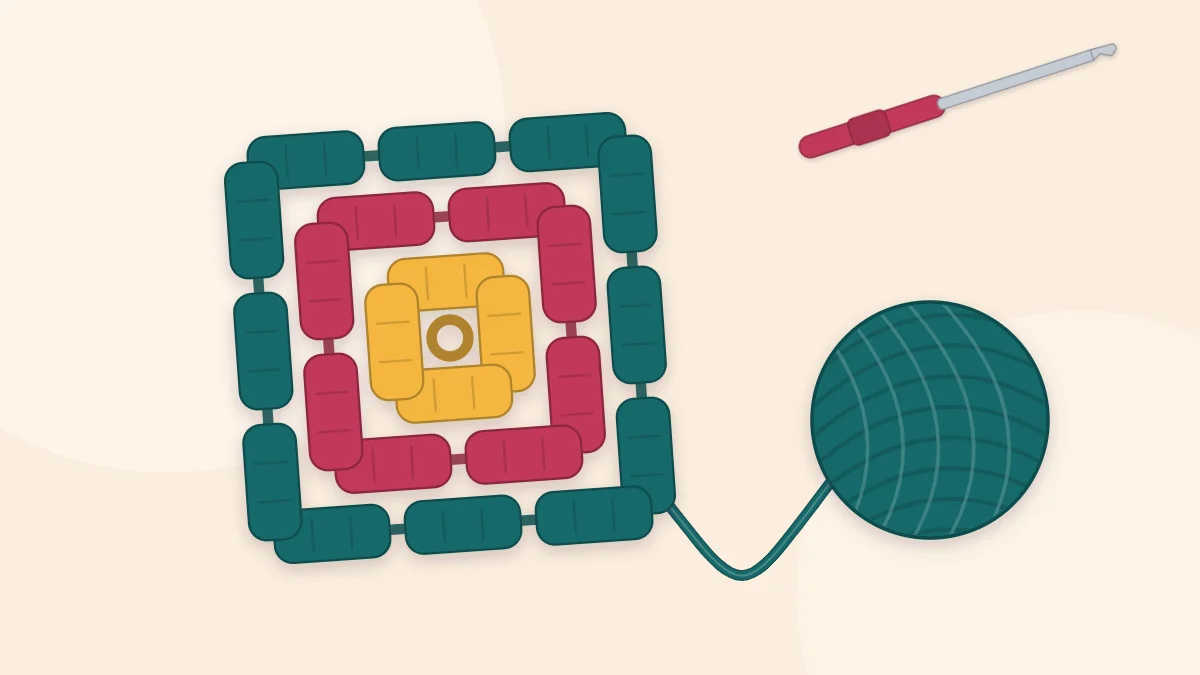
Tutorial at a glance
Materials
- Yarn needle
- Scissors
A classic granny square is built from groups of three double crochet stitches, called clusters, worked in rounds around a small ring. Every corner gets two clusters with a chain-2 space between them, every side gains one cluster per round, and that is the whole pattern. The three-round square below is the usual place to start: it is small enough to finish in one sitting, and it teaches every move a larger square needs.
The pattern is written in US crochet terms. The US double crochet (dc) is the stitch that UK patterns call a treble (tr).
What You Need
- Worsted weight (4) yarn in one, two or three colors. A smooth, light-colored acrylic or cotton makes the stitches easiest to see.
- A US H-8 (5 mm) crochet hook.
- A yarn needle and scissors.
With this yarn and hook, three rounds usually land somewhere around 4 in (10 cm) across. Treat that as an estimate: yarn, hook and tension all change it, so make one square and measure it before planning a project.
Abbreviations and Stitches
| Abbreviation | Meaning |
|---|---|
| ch | chain |
| sl st | slip stitch |
| dc | double crochet |
| st(s) | stitch(es) |
| sp | space |
| ch-sp | chain space, the gap under a chain |
| rnd | round |
| yo | yarn over |
Double crochet: yo, insert the hook, yo and pull up a loop (3 loops on the hook), yo and pull through 2 loops, yo and pull through the last 2 loops.
Cluster: in this pattern, 3 dc worked into the same space. Corner: (3 dc, ch 2, 3 dc) worked into one space.
Parentheses hold stitches that all go into one space. Square brackets hold a sequence that is repeated the number of times given after them. The Craft Yarn Council abbreviation list covers the standard terms, and the guide to reading granny square patterns explains the punctuation in more depth.
Start With a Ring
Make a slip knot, ch 4, and sl st into the first chain to close the chains into a ring. Round 1 is worked into the hole in the middle of that ring, not into the individual chains.
Magic ring option: wrap the yarn once around two fingers so the tail crosses under the working yarn, insert the hook under the loop, pull the working yarn through and ch 1 to secure it. Work round 1 over both the loop and the tail, then pull the tail to draw the center closed. It leaves no hole, but the tail has to be woven in firmly or the ring can loosen.
The Three-Round Pattern
Round 1
- Ch 3 (counts as the first dc), then work 2 dc into the ring. That is the first cluster.
- Ch 2 for the first corner.
- [3 dc into the ring, ch 2] 3 times.
- Join with a sl st to the top of the beginning ch 3.
Count: 4 clusters (12 dc) and 4 ch-2 corner spaces.
Round 2
- Sl st in each of the next 2 dc and into the ch-2 corner space. This moves the hook to the corner without adding height.
- (Ch 3, 2 dc, ch 2, 3 dc) in the same corner space, ch 1.
- [(3 dc, ch 2, 3 dc) in the next ch-2 corner space, ch 1] 3 times.
- Join with a sl st to the top of the beginning ch 3.
Count: 8 clusters (24 dc), 4 ch-2 corner spaces and 4 ch-1 side spaces.
Round 3
- Sl st in each of the next 2 dc and into the ch-2 corner space.
- (Ch 3, 2 dc, ch 2, 3 dc) in the same corner space, ch 1, 3 dc in the next ch-1 space, ch 1.
- [(3 dc, ch 2, 3 dc) in the next ch-2 corner space, ch 1, 3 dc in the next ch-1 space, ch 1] 3 times.
- Join with a sl st to the top of the beginning ch 3.
Count: 12 clusters (36 dc), 4 ch-2 corner spaces and 8 ch-1 side spaces.
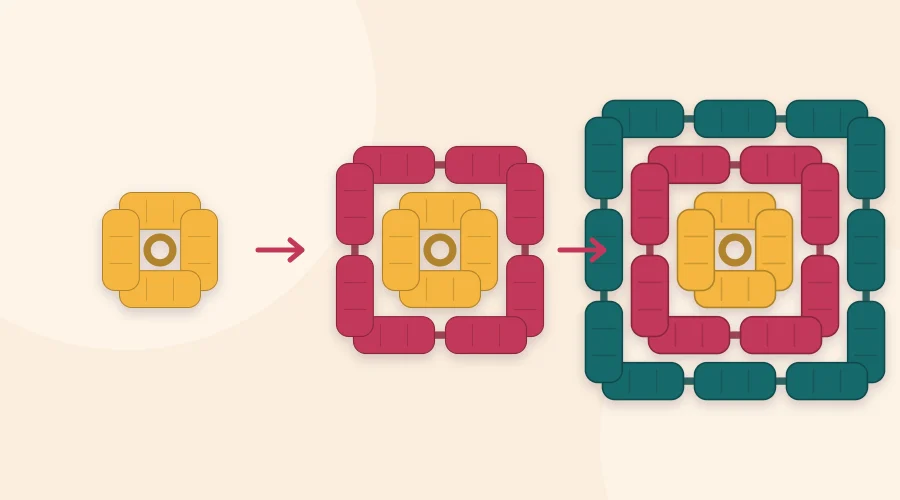
Tip
The round number tells you how many clusters each side should have, counting the corner clusters at both ends: 2 per side in round 2, 3 per side in round 3. Check all four sides before joining.
How the Corners Work
The corner is the only place where two clusters share a space. The ch 2 between them is what lets the fabric turn 90 degrees and lie flat; along the sides, the single chain between clusters only has to bridge a small gap. If a corner gets one cluster instead of two, or the ch 2 is forgotten, the square starts to round off and pull inward.
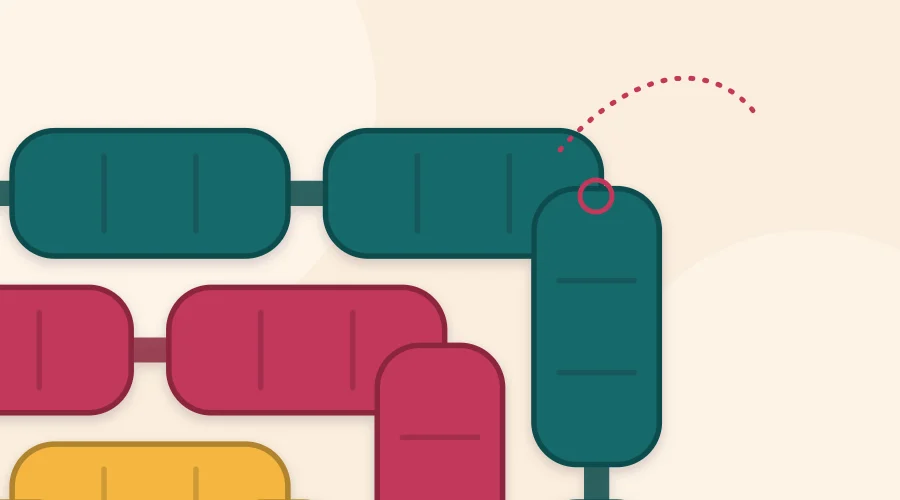
Watch out
Join each round into the third chain of the beginning ch 3, the very top, not into the side of the chain or the space beside it. Joining low leaves a visible gap and makes the first cluster hard to find on the next round.
Changing Color Between Rounds
For a striped square, finish the round, cut the yarn and pull the tail through the loop on the hook. Attach the new color with a sl st in any ch-2 corner space, then start at step 2 of the next round; the slip stitches in step 1 are only needed when the same yarn carries on. Starting each color in a different corner spreads the joins around the square. There is a full walkthrough in the guide to changing colors in a granny square.
Fastening Off
After the last join, cut the yarn about 6 in (15 cm) from the hook, yo and pull the tail all the way through the loop, then tug it snug. Thread each tail onto the yarn needle and weave it through the back of the stitches, changing direction at least once so it cannot work loose.
Making the Square Bigger
Round 3 already contains every instruction a larger square uses. For each new round, sl st to the corner, work a corner in every ch-2 space and one cluster in every ch-1 space, with ch 1 after each cluster group. Every side grows by one cluster per round, so round 4 has 16 clusters (48 dc) and 12 ch-1 spaces, and round 5 has 20 clusters (60 dc) and 16 ch-1 spaces.
Once the cluster square feels easy, the solid granny square is a natural next step: same ring, same corners, but with the gaps filled in.
Frequently asked questions
Should a beginner use a chain ring or a magic ring?
A chain-4 ring is easier to hold and cannot come undone, so it is the simpler choice for a first square. A magic ring closes the center hole completely but needs its tail woven in securely.
Why is my granny square not flat?
A square that ruffles usually has too many stitches or chains, and one that cups has too few or is worked too tightly. Count the clusters on each side and check that every corner has a chain 2 between its two clusters.
How many rounds does a granny square need?
There is no fixed number. Three rounds make a small square for joining into blankets and bags, and the same rule of one extra cluster per side lets you keep adding rounds to any size.
Do I have to change color every round?
No. The square can be worked in one color by slip stitching to the next corner at the start of each round, or with a new color joined in a corner space for every round.

