How to Read Granny Square Patterns: Abbreviations, Brackets and Charts
Written granny square patterns pack a lot into a few lines. Here is what the abbreviations, brackets, asterisks, stitch counts and chart symbols mean.
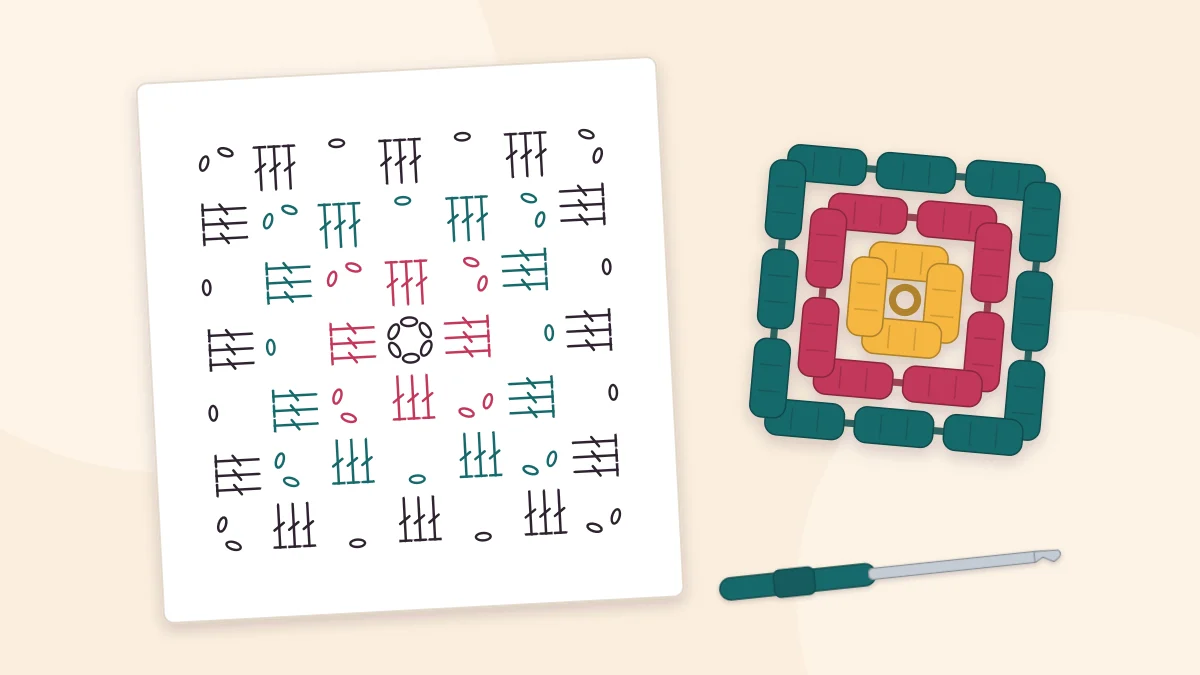
A granny square pattern is a set of compressed instructions: abbreviations name the stitches, punctuation tells you where to put them and how many times to repeat them, and the number at the end of each round tells you whether you got it right. Once you can decode those three layers, almost any square becomes readable, whether it is written out in words or drawn as a symbol chart.
Start With the Notes Before Round 1
The lines above the first round are easy to skip and they answer most questions before they come up. Look for four things:
- Terminology. A pattern is written in either US or UK terms, and the same letters mean different stitches. A US double crochet (dc) is a UK treble (tr); a US single crochet (sc) is a UK double crochet (dc). Everything on this page uses US terms.
- Turning chain rule. Most patterns say something like “ch 3 counts as first dc”. That sentence decides how you count every round.
- Materials and gauge. Yarn weight, hook size and the size the designer expects the square to reach. Your own square may differ, which is why the granny square size guide suggests making and measuring one before starting a project.
- Special stitches. Clusters, puffs, bobbles and popcorns are defined once at the top and then used by name.
The Abbreviations You Will Meet Most Often
Granny squares use a small vocabulary. These are the standard US abbreviations, as listed by the Craft Yarn Council.
| Abbreviation | Meaning |
|---|---|
| ch | chain |
| sl st | slip stitch |
| sc | single crochet |
| hdc | half double crochet |
| dc | double crochet |
| tr | treble crochet |
| st(s) | stitch(es) |
| sp(s) | space(s) |
| ch-sp | chain space, the gap under a chain |
| sk | skip |
| rep | repeat |
| rnd | round |
| yo | yarn over |
| RS / WS | right side / wrong side |
Notice the hyphen. “Ch 2” is an instruction: make two chains. “Ch-2 sp” is a place: the space under a chain of two made in the round before. Mixing those up is the most common beginner misreading.
What the Punctuation Means
Punctuation does the heavy lifting in a written round. Designers differ a little, but the conventions below are close to universal.
Parentheses
Parentheses usually group stitches that all go into the same place. “(3 dc, ch 2, 3 dc) in next ch-2 sp” means the whole group is worked into that one corner space. Parentheses are also used for side notes, such as “ch 3 (counts as dc)”.
Brackets
Square brackets mark a sequence to repeat a stated number of times: “[3 dc, ch 2] 3 times” means work three double crochets and two chains, then do it again, and again.
Asterisks
An asterisk marks the start of a repeat. “*3 dc in next sp, ch 1; rep from * 2 more times” means work the instruction once, then twice more, for three in total. Read the wording closely: “rep from * 3 times” and “rep from * 3 more times” are not the same number.
Commas and Semicolons
A comma separates one action from the next. A semicolon usually closes a repeat section. Work one action at a time and move a finger or a sticky note along the line as you go.
Decoding One Round, Phrase by Phrase
Here is a typical second round of a classic square, where Rnd 1 made four 3-dc clusters and four ch-2 corner spaces:
Rnd 2: Sl st to first ch-2 sp, ch 3 (counts as dc), (2 dc, ch 2, 3 dc) in same sp, ch 1, *(3 dc, ch 2, 3 dc) in next ch-2 sp, ch 1; rep from * 2 more times, join with sl st in top of ch-3. (8 clusters, 4 ch-2 corner sps, 4 ch-1 sps)
- Sl st to first ch-2 sp. Slip stitch across the tops of the stitches until the hook sits in a corner space.
- Ch 3 (counts as dc). These three chains stand in for the first double crochet.
- (2 dc, ch 2, 3 dc) in same sp. With the ch-3, that makes a full corner: three dc, two chains, three dc, all in one space.
- Ch 1. A single chain bridges the side to the next corner.
- *…; rep from * 2 more times. Make a corner in each of the other three corner spaces, each followed by a ch 1.
- Join with sl st in top of ch-3. Close the round in the third chain of the starting chain.
Now check the count in parentheses: four corners of two clusters each is eight clusters, or 24 dc. If yours match, move on. If not, the mistake is in this round and is quick to find. The full square is written out in how to crochet a granny square.
Tip
Count at the end of every round, not at the end of the square. A missing cluster in Rnd 2 throws off every round after it.
How to Read a Symbol Chart
A chart shows the same information as a picture. Each stitch has a symbol, and the symbols sit where the stitches sit in the fabric.
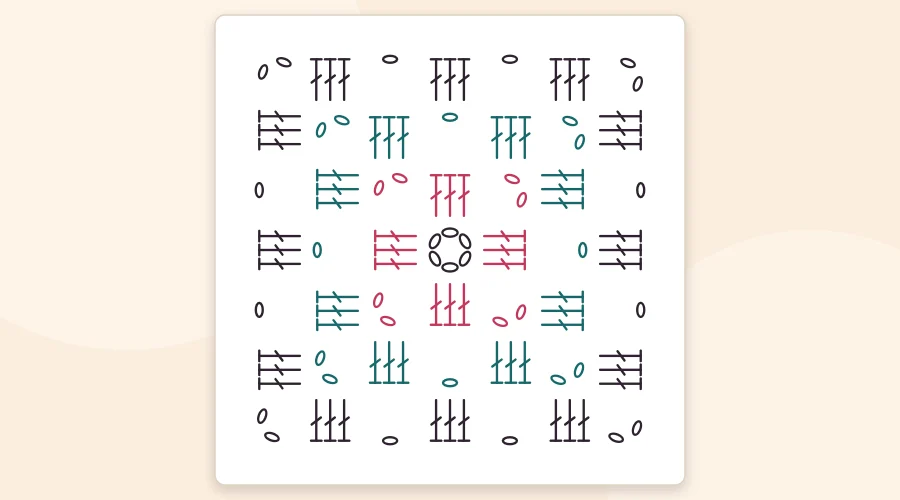
- Oval: chain.
- Dot or small filled oval: slip stitch.
- X or plus sign: single crochet.
- T: half double crochet.
- T with one slash across the stem: double crochet. The slash stands for the yarn over.
- T with two slashes: treble crochet.
Charts for squares worked in the round are read from the center outward. Find the starting ring in the middle, then follow each round counterclockwise if you are right-handed, since that is the direction you crochet. Left-handed crocheters follow it clockwise. Rounds are normally numbered at their starting point, and many charts alternate two colors so that neighboring rounds are easy to tell apart.
Where the stems of several symbols meet at one point, those stitches share one stitch or space. Three T-bars fanning out of a gap is a 3-dc cluster worked into a space; an arc of ovals at a corner is the corner chain.
Watch out
A chart shows the right side of the work and does not say whether to turn. If the written pattern says to turn after each round, follow the text.
When the Pattern and Your Square Disagree
- Too many or too few stitches. Check whether the starting chain counts as a stitch, then recount the repeats.
- A corner has gone missing. Every round needs four corners, each with its own chain space. See common granny square mistakes for the fix.
- The stitches look too short or too tall. Confirm whether the pattern uses US or UK terms.
- The text is unclear. If a chart is included, compare the two. One usually explains the other.
Reading patterns is a skill that grows with use. A plain solid granny square is good practice, because every round follows the same logic and the stitch count rises by a fixed amount each time.
Frequently asked questions
What does the asterisk mean in a crochet pattern?
An asterisk marks the start of a section to repeat. Work the instructions after it once, then repeat them the number of times the pattern states, paying attention to whether it says "times" or "more times".
Does the chain 3 at the start of a round count as a stitch?
In most granny square patterns the chain 3 counts as the first double crochet, but not in all. The pattern notes or the round itself should say so, and the stitch count at the end of the round will confirm it.
Which direction do you read a crochet chart worked in the round?
Start at the center and work outward, round by round. Right-handed crocheters follow each round counterclockwise and left-handed crocheters follow it clockwise.
How can you tell whether a pattern uses US or UK terms?
Good patterns state it in the notes. If not, look for single crochet (sc): it exists only in US terminology, so a pattern that uses sc is written in US terms.