Granny Square Blanket Sizes: How Many Squares You Need
A reference chart of how many granny squares go into baby, throw, twin and queen blankets at four square sizes, with the formula for working out any other size.

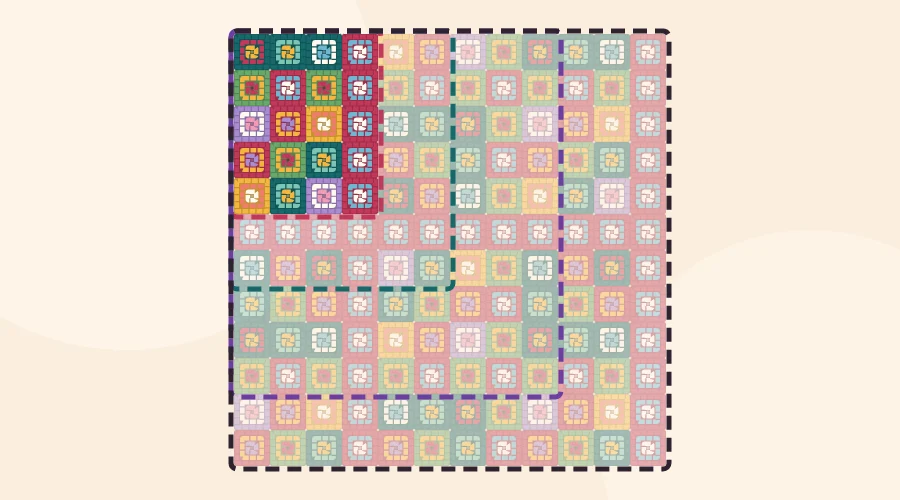
The number of granny squares in a blanket comes from one formula: divide the blanket’s width and length by the width of one square, round each result to a whole number, and multiply. A throw of about 50 by 60 in (127 by 152 cm) takes 120 squares at 5 in (13 cm) each, or 48 squares at 8 in (20 cm). The chart below does the same sum for four blanket sizes and four square sizes.
Granny Square Blanket Size Chart
Each cell shows squares across by squares down, then the total. The blanket dimensions are common targets, not fixed standards; mattress sizes and personal taste vary, so adjust them freely.
| Blanket (Target Size) | 4 in (10 cm) Squares | 5 in (13 cm) Squares | 6 in (15 cm) Squares | 8 in (20 cm) Squares |
|---|---|---|---|---|
| Baby, 30 x 36 in (76 x 91 cm) | 8 x 9 = 72 | 6 x 7 = 42 | 5 x 6 = 30 | 4 x 5 = 20 |
| Lap or throw, 50 x 60 in (127 x 152 cm) | 13 x 15 = 195 | 10 x 12 = 120 | 8 x 10 = 80 | 6 x 8 = 48 |
| Twin, 66 x 90 in (168 x 229 cm) | 17 x 23 = 391 | 13 x 18 = 234 | 11 x 15 = 165 | 8 x 11 = 88 |
| Queen, 90 x 100 in (229 x 254 cm) | 23 x 25 = 575 | 18 x 20 = 360 | 15 x 17 = 255 | 11 x 13 = 143 |
These counts are arithmetic, based on squares that measure exactly the stated size once blocked. They do not include a border, and real squares rarely match a round number, so use the chart to get a sense of scale and the formula below for your own project.
The Formula
- Measure one finished, blocked square from side to side. Call this the square size.
- Squares across = target width divided by square size, rounded to the nearest whole number.
- Squares down = target length divided by square size, rounded to the nearest whole number.
- Total squares = squares across multiplied by squares down.
- Actual blanket size = squares across multiplied by square size, by squares down multiplied by square size.
A Worked Example
Suppose a sample square measures 5.5 in (14 cm) and the goal is a twin blanket of 66 by 90 in (168 by 229 cm).
- Across: 66 divided by 5.5 is exactly 12.
- Down: 90 divided by 5.5 is about 16.4, which rounds to 16.
- Total: 12 multiplied by 16 is 192 squares.
- Actual size: 66 by 88 in (168 by 224 cm) before any border.
The blanket ends up 2 in (5 cm) shorter than the target. A border about 1 in (2.5 cm) deep adds 2 in (5 cm) to each dimension, giving roughly 68 by 90 in (173 by 229 cm).
Why the Chart Rounds the Way It Does
Squares cannot be cut, so most combinations miss the target by a little. In the chart, anything at or above a half square is rounded up and anything below is rounded down. Some results land exactly on the target and others drift:
| Combination | Grid | Actual Size |
|---|---|---|
| Baby with 5 in squares | 6 x 7 | 30 x 35 in (76 x 89 cm) |
| Baby with 8 in squares | 4 x 5 | 32 x 40 in (81 x 102 cm) |
| Throw with 6 in squares | 8 x 10 | 48 x 60 in (122 x 152 cm) |
| Twin with 8 in squares | 8 x 11 | 64 x 88 in (163 x 224 cm) |
| Queen with 6 in squares | 15 x 17 | 90 x 102 in (229 x 259 cm) |
If rounding leaves the blanket too small, there are three fixes: add one more row or column, add a round to every square, or make up the difference with a wider border. Large squares give the coarsest steps, since each extra row adds a full 8 in (20 cm).
Tip
Round the width down and the length up if you are unsure. A blanket that is slightly narrow and slightly long still covers a person or a bed well, and a border can add width later.
Allowing for Borders and Seams
A border adds its depth twice to each dimension, once on each side. To hit a target size with a border included, subtract twice the border depth from the width and the length before dividing. For a 50 by 60 in (127 by 152 cm) throw with a 2 in (5 cm) border, the squares need to fill 46 by 56 in (117 by 142 cm). With 5 in (13 cm) squares that is 9 by 11, or 99 squares, instead of 120. Border styles and how deep each tends to be are covered in the guide to adding a granny square border.
Seams matter less, but they are not nothing. A flat sewn seam adds almost no width. A crocheted join that places a row of stitches or chains between squares adds a small amount at every seam, and across a dozen or more seams that can come to several inches. If you plan to use a wide decorative join, connect two sample squares and measure the pair to see how much the join contributes.
Choosing a Square Size From the Chart
The chart makes the trade-off visible. A queen blanket in 4 in (10 cm) squares needs 575 of them; in 8 in (20 cm) squares it needs 143. Each of the larger squares takes longer to crochet, because it has more rounds, but the number of ends to weave and seams to work drops sharply.
- Small squares suit baby blankets, scrap projects and detailed color layouts.
- Medium squares are a comfortable choice for throws.
- Large squares make bed-size blankets realistic and keep the fabric soft, with fewer seams.
If the counts for a bed-size blanket look daunting at any square size, a single square worked outward until it is big enough avoids joining altogether; see the giant granny square blanket.
Watch out
Do not rely on the size a pattern says its square will be. Yarn, hook and tension change it. Measure your own blocked square, and check again partway through the project, because tension often loosens with practice.
Before You Start Counting
Every number on this page depends on the square size, so that measurement deserves care. The granny square size guide explains how to measure accurately and how rounds, yarn weight and hook size change the result. Once the grid is settled, the planning steps for layout, joining and finishing are in the granny square blanket guide.
Frequently asked questions
How many granny squares do I need for a throw blanket?
For a throw of about 50 by 60 inches, plan on 120 squares at 5 inches, 80 squares at 6 inches or 48 squares at 8 inches. Measure your own square first, since the count depends on its real size.
How many granny squares make a baby blanket?
For about 30 by 36 inches, that is 72 squares at 4 inches, 42 at 5 inches, 30 at 6 inches or 20 at 8 inches.
Does a border change how many squares I need?
Yes. A border adds its depth to both sides of each dimension, so subtract twice the border depth from the target width and length before dividing by the square size.
What if my squares do not divide evenly into the blanket size?
Round to the nearest whole square and accept a slightly different finished size, or make up the difference with an extra row, an extra round on every square or a wider border.